Cédric Driaux
Founder of tryVidimus
Cédric Driaux is the founder of tryVidimus, published by Fyher. He has been a software developer for 23 years. He also builds ScanStay, a photo proof tool for short-term rental hosts.
Articles
Photo evidencePhoto evidence holds up when four things can be checked by someone who does not trust you: the photo was taken live, an independent authority dated it, nothing changed since, and anyone can verify all of that without your help.
9 min read
StandardsThree photo authenticity standards do the work. C2PA records where a file comes from and makes changes visible. An eIDAS qualified timestamp certifies the date. RFC 3161 is the protocol that lets anyone check that timestamp.
10 min read
Use casesPhoto evidence use cases share one pattern: something changes hands or changes state, and two parties may later disagree about it. A live capture, sealed and dated by a third party before the disagreement, gives both sides the same record.
11 min read

DevelopersA photo evidence API lets your app open a live capture page, then returns a sealed proof: SHA-256 fingerprints, a qualified timestamp, a C2PA signature and a public verification link. Your server makes one call and receives one webhook.
12 min read
Photo evidenceYes, a photo can be used as evidence in many disputes. Its weight depends on three things the other side can challenge: where the photo comes from, when it was taken, and whether it changed afterwards.
7 min read
Photo evidenceYes, EXIF data can be faked. The date, location and device stored in a photo are plain fields that common tools can rewrite, and nothing in the file records the change. EXIF is useful context, not proof.
7 min read
Photo evidenceTo prove a photo has not been edited, seal it at capture: compute a fingerprint of the file, bind it to a date certified by a third party, and sign it. Any later change is then detectable by anyone.
7 min read
Photo evidenceTo prove when a photo was taken, do not rely on the phone. Capture the photo live and have an independent timestamp authority certify, at that moment, that the file existed. The date then no longer depends on either party.
7 min read
Photo evidenceA WhatsApp photo or a screenshot can usually be shown in a dispute, but it is weak evidence. What arrives is a copy, its date is the date of the message, and the other side cannot check its origin.
7 min read
StandardsA qualified timestamp under eIDAS is an electronic time stamp issued by a qualified trust service provider. In the European Union, it enjoys a presumption that its date and time are accurate and that the data it covers is unchanged.
8 min read
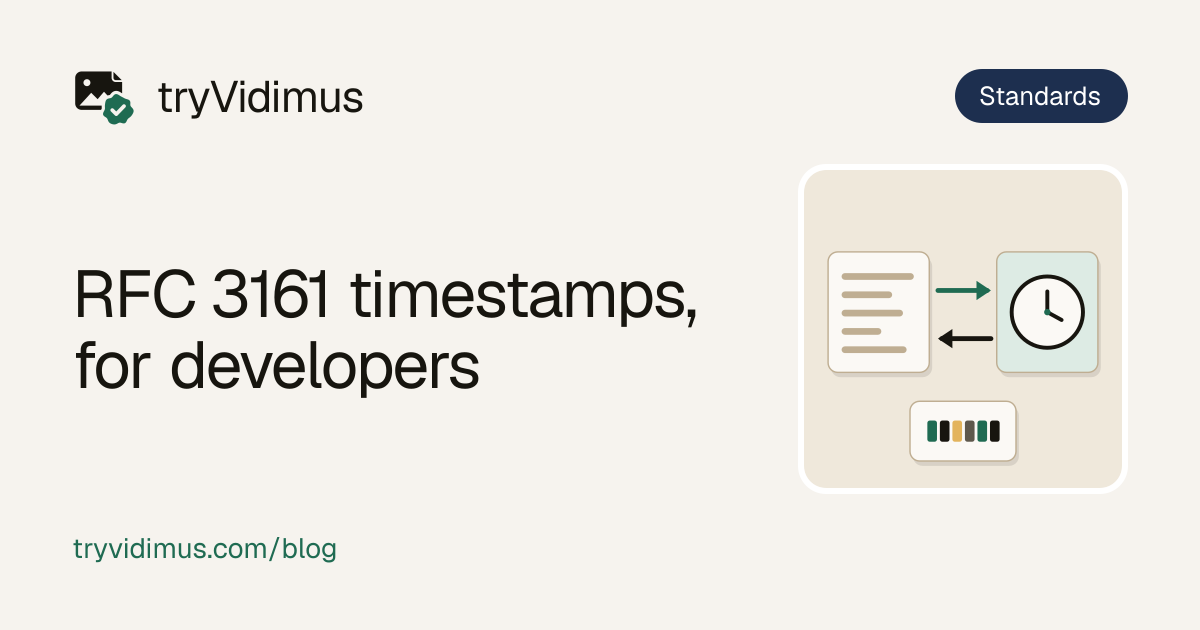
StandardsAn RFC 3161 timestamp is a signed token from a timestamp authority that binds the hash of your data to a time. You send a hash, you get the token back, and anyone can verify it later with standard tools.
7 min read
StandardsC2PA is an open standard that attaches a signed record to a file: which tool produced it and what happened to it since. Its public name is Content Credentials. It makes edits visible; it does not prevent them.
7 min read
Use casesConstruction photo documentation holds up when each photo is captured live, dated by an independent authority, sealed against later changes and open to verification by the client, the insurer or an expert, without relying on the contractor's word.
7 min read
Use casesA sealed, live capture tells the claims handler three things about insurance claim photos: they came from the camera at that moment, when they were sealed, and that they have not changed since. It does not assess the damage.
8 min read
Use casesA proof of delivery photo holds up when it is captured live, dated by an independent authority and sealed, so the customer, the carrier and the seller can each check when it was taken and that nothing changed since.
7 min read
Use casesProperty inspection photos hold up when they are captured live at move-in and move-out, dated by an independent authority, sealed against changes and open to verification by the tenant. They support the written inspection report and do not replace it.
7 min read

Use casesRental car damage proof rests on two live captures, one at pickup and one at return, with the same shot list. Each is sealed and dated by a third party, and both are filed under the booking reference.
7 min read
DevelopersA tamper-proof photo capture API needs one call from your server. You create a capture session, open the link it returns, wait for the proof.sealed webhook, then share the public verification link. The capture page does the rest.
7 min read
DevelopersPhoto evidence webhooks tell your server the moment a proof is sealed. You declare an HTTPS endpoint, check the HMAC-SHA256 signature of each call, ignore duplicates with the event identifier, and attach the proof to your booking.
6 min read
DevelopersTo verify photo authenticity programmatically, fetch the public bundle of the proof, recompute the SHA-256 fingerprint of the file you hold, and check the RFC 3161 timestamp token. The open-source verifier does it without trusting our servers.
7 min read
Choosing a solutionTo choose a photo evidence API, ask each vendor ten questions: where photos come from, who certifies the date, which standards apply, who can verify, where data lives and how you pay. Good answers can be checked without the vendor.
8 min read
Choosing a solutionThe right Truepic alternative depends on what you are building. Truepic sells a virtual inspection platform. If you need sealed photos inside your own product, an API fits better. If your team certifies content itself, a certification app does.
8 min read